NSF BRIDGE Conference on Cyberinfrastructure for Collaborative Data Science and AI, 2026
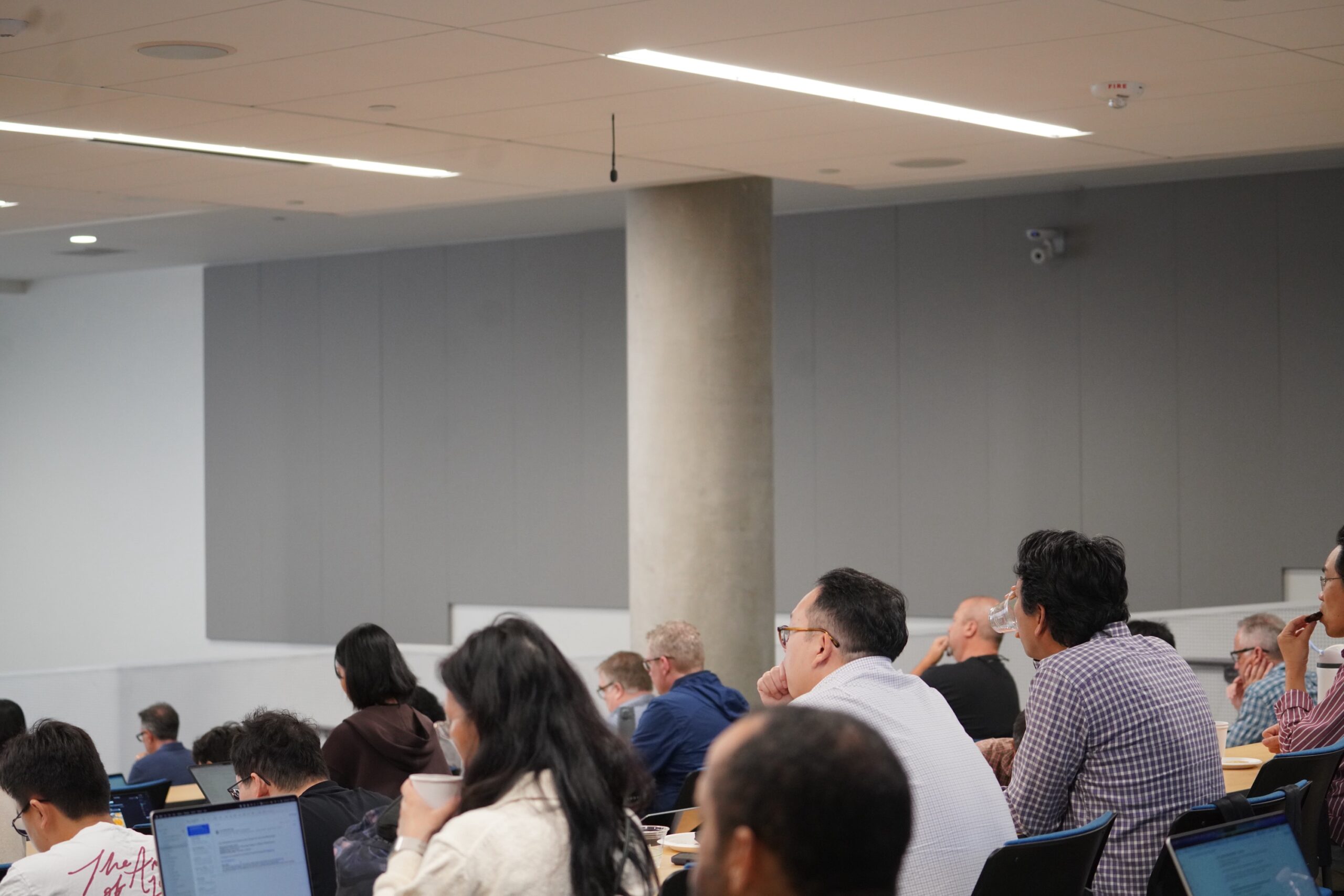
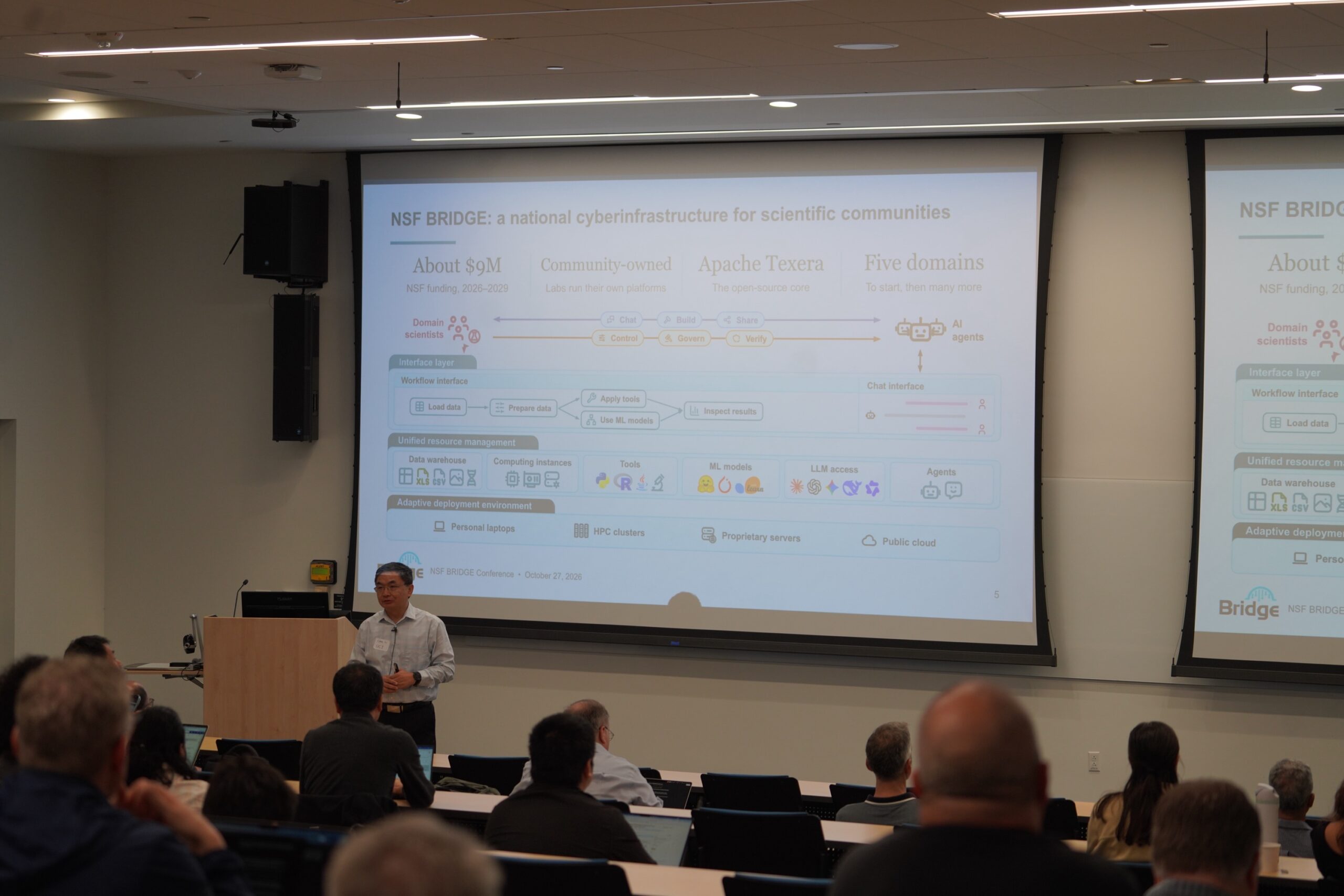
An afternoon gathering of the NSF BRIDGE community: researchers, domain scientists, and partners who came together to share progress, shape the roadmap, and connect the communities BRIDGE serves.
Thank you to everyone who joined the NSF BRIDGE Conference on October 27!
Overview
Bringing the BRIDGE community together
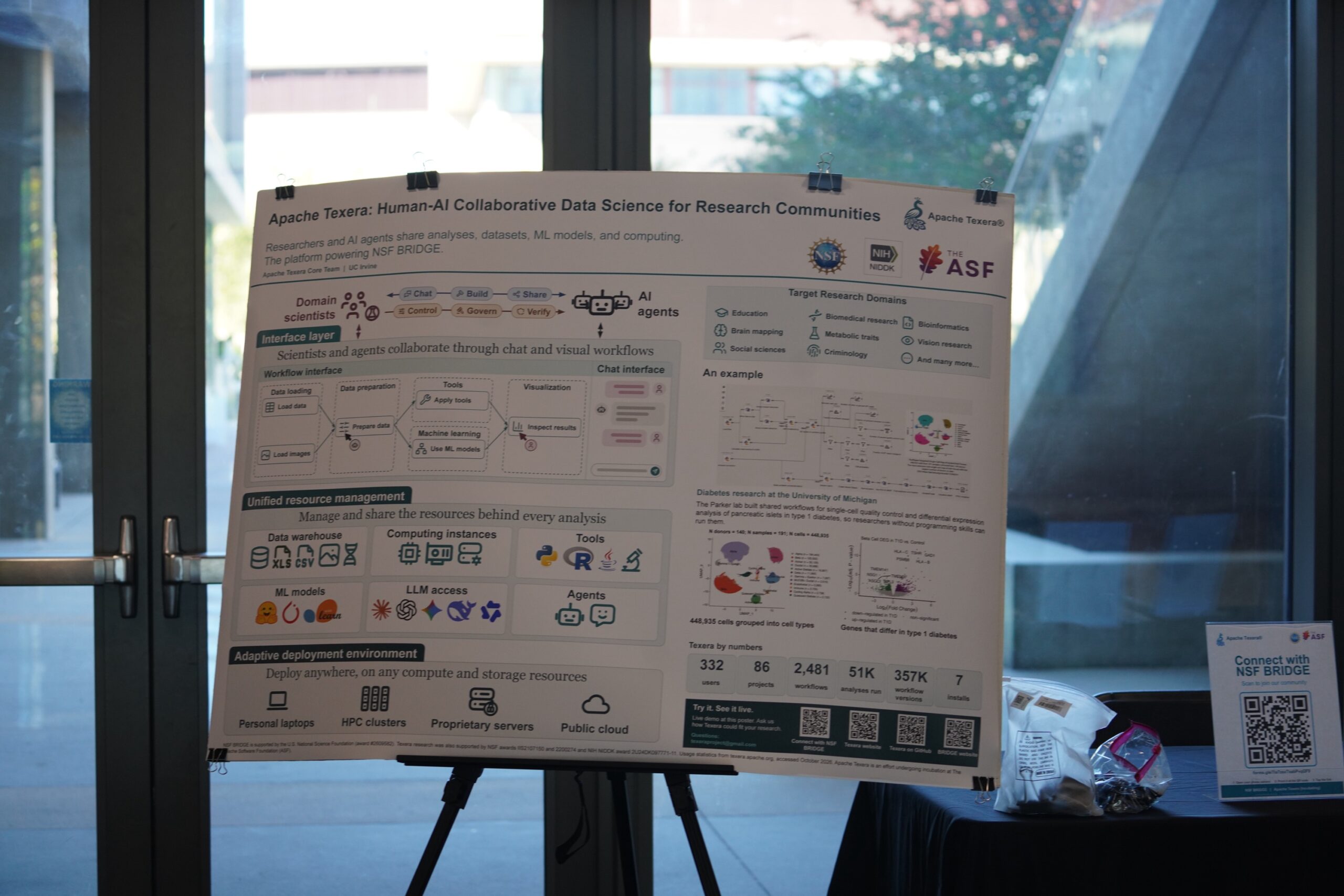
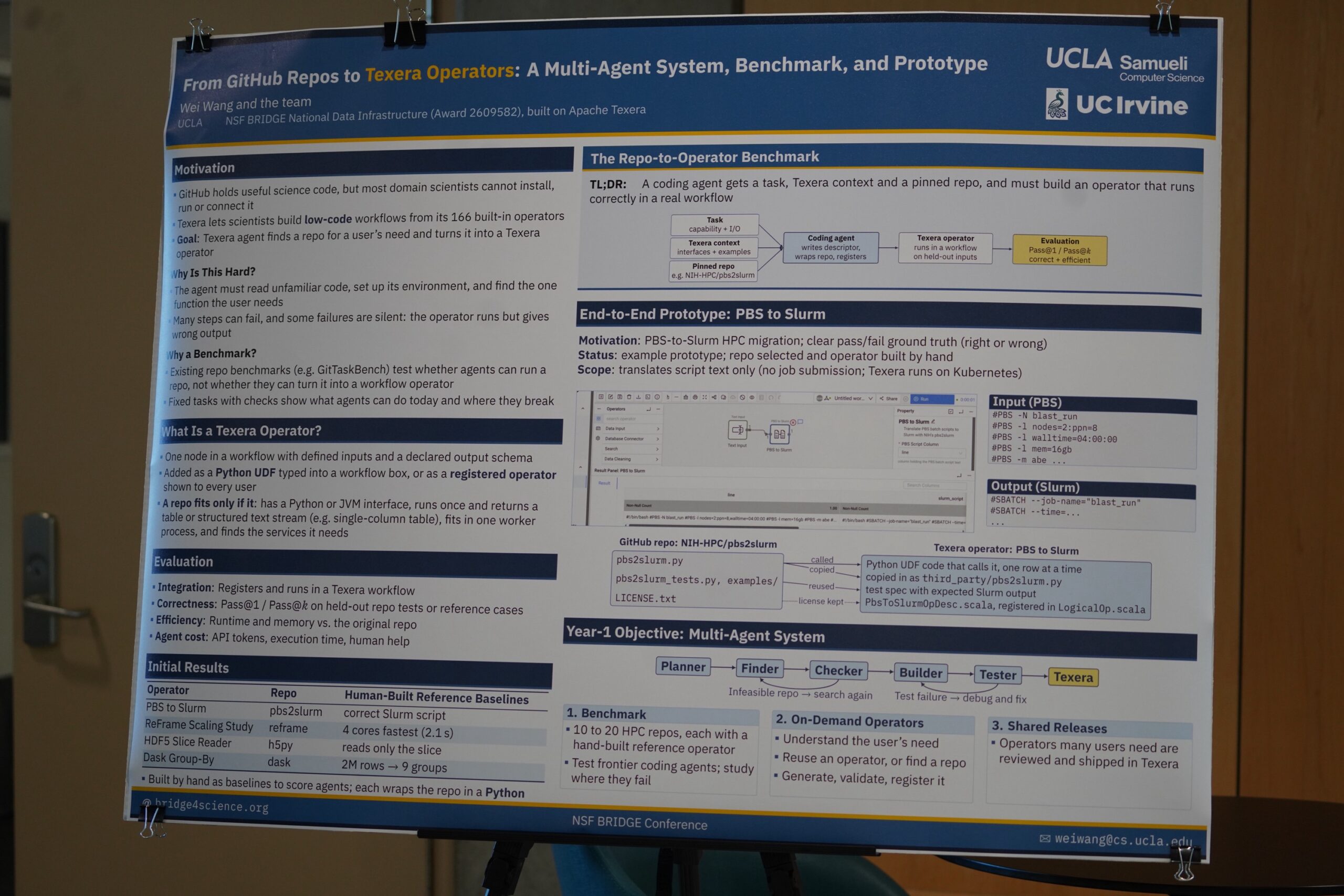
The NSF BRIDGE Conference gathers the project’s investigators, collaborating research labs, and domain communities for an afternoon of talks, demonstrations, and hands-on sessions. Attendees saw how BRIDGE and Apache Texera (Incubating) lower the barriers to modern data science and AI, and helped shape where BRIDGE goes next.
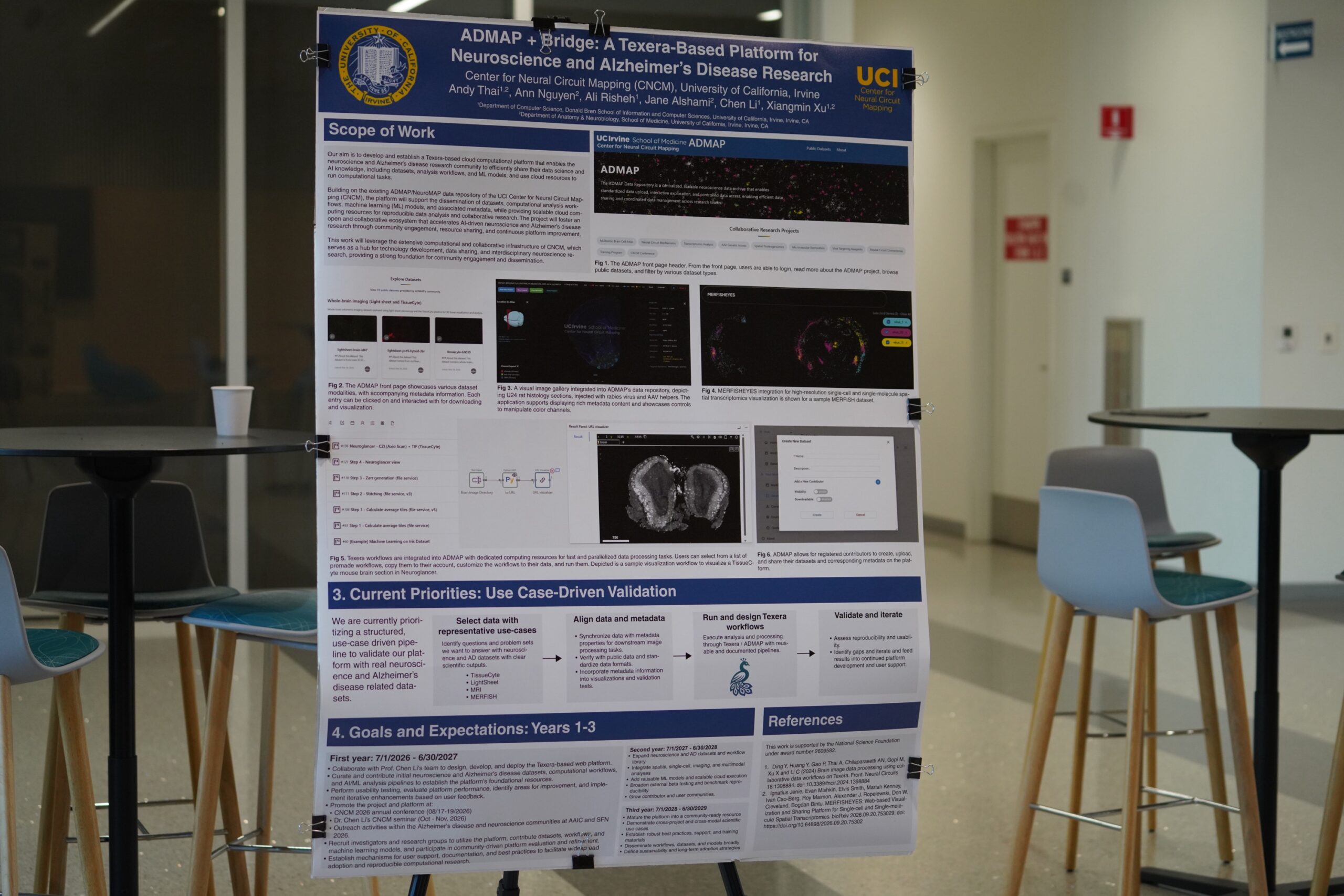
The conference focused on BRIDGE’s five initial research communities: Vision, Brain Mapping, Metabolic Traits, Social Sciences, and High Performance Computing (HPC). Through talks, demonstrations, and hands-on sessions with Apache Texera (Incubating), participants shared research needs, explore workflows, and help identify priorities for platform development, training, and support.
Event details
Date
Tuesday, October 27, 2026
Location
ISEB Auditorium 1010, UC Irvine, Irvine, CA
Format
Afternoon conference, 1:00 – 5:00 PM
Host
NSF BRIDGE: UC Irvine, UCLA, University of Michigan
Program
Tuesday, October 27, 2026 · ISEB Auditorium 1010, UC Irvine.
⚑
Event completed. Thank you to everyone who joined us on October 27, 2026. Photos and slides are posted below.
| Time | Session |
|---|---|
| 1:00 – 1:15 | Welcome remarks VCR and the ICS Dean’s Office |
| 1:15 – 1:45 | Overview of NSF BRIDGE Chen Li Slides (PDF) |
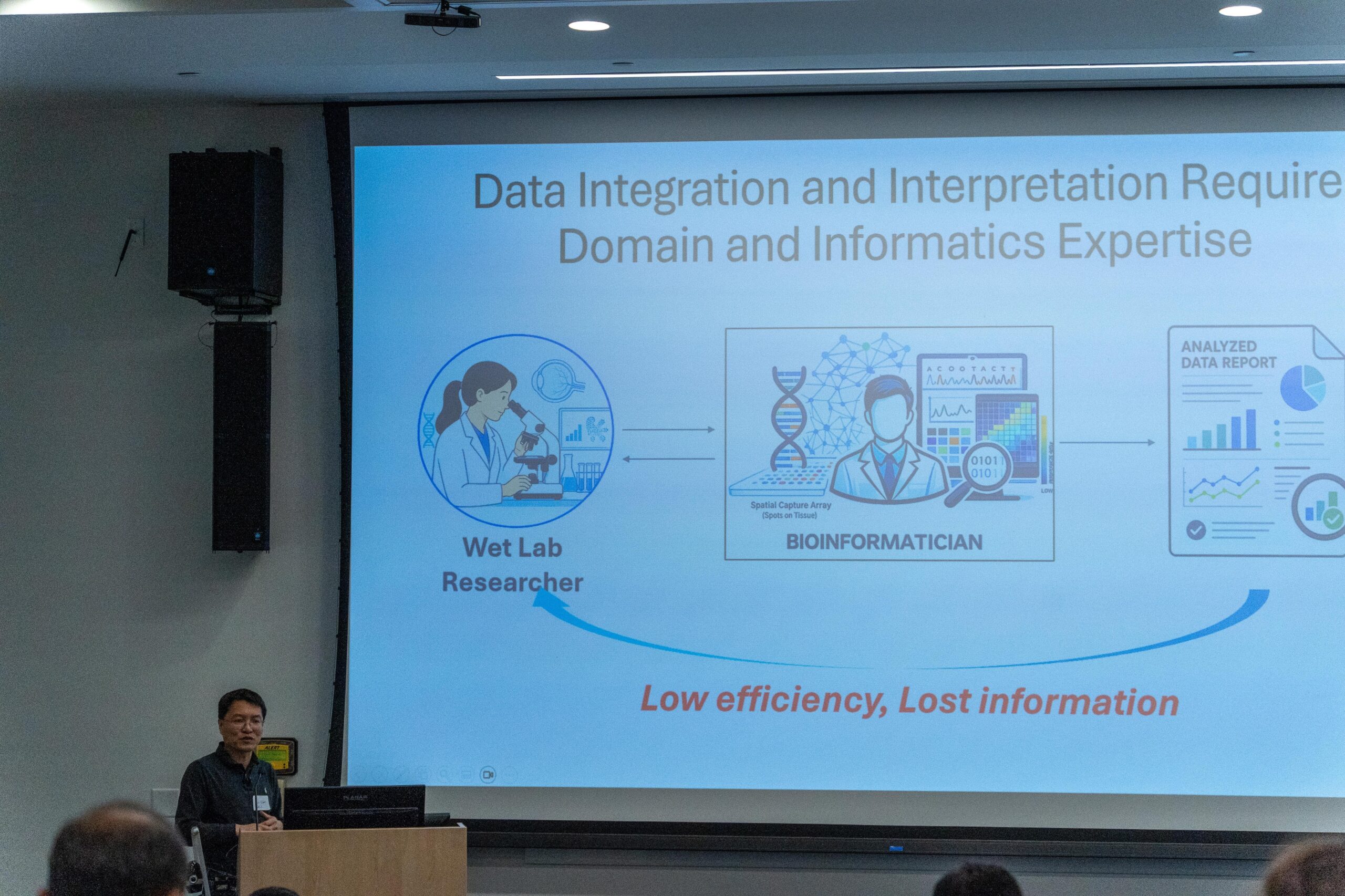
| 1:45 – 2:15 | Bridging AI and Biomedical Research Rui Chen, Xiangmin Xu, and Steve Parker Slides (PDF) |
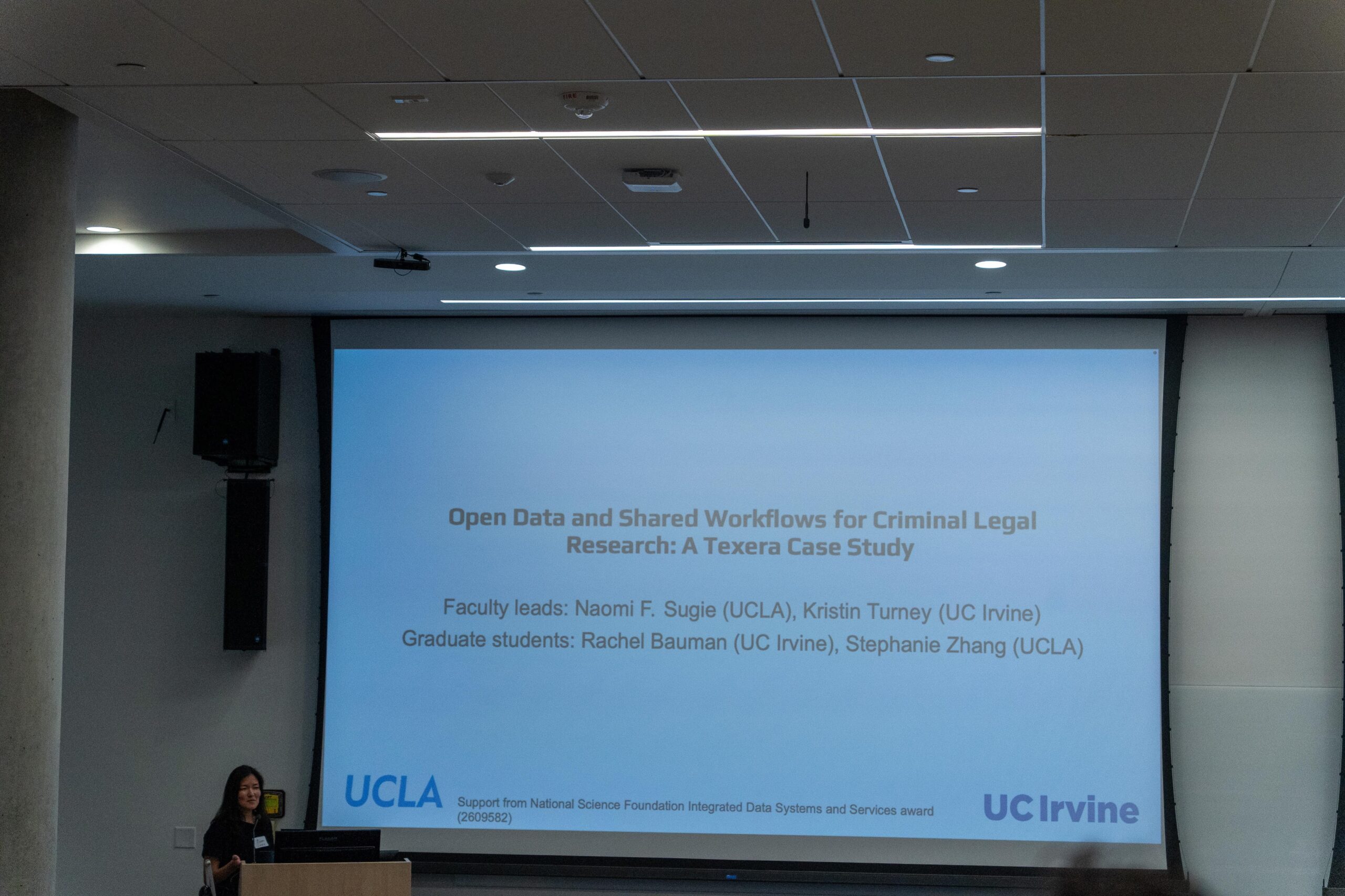
| 2:15 – 2:35 | Open Data and Shared Workflows for Criminal Legal Research: A Texera Case Study Social Sciences domain · Naomi Sugie (UCLA) Slides (PDF) |
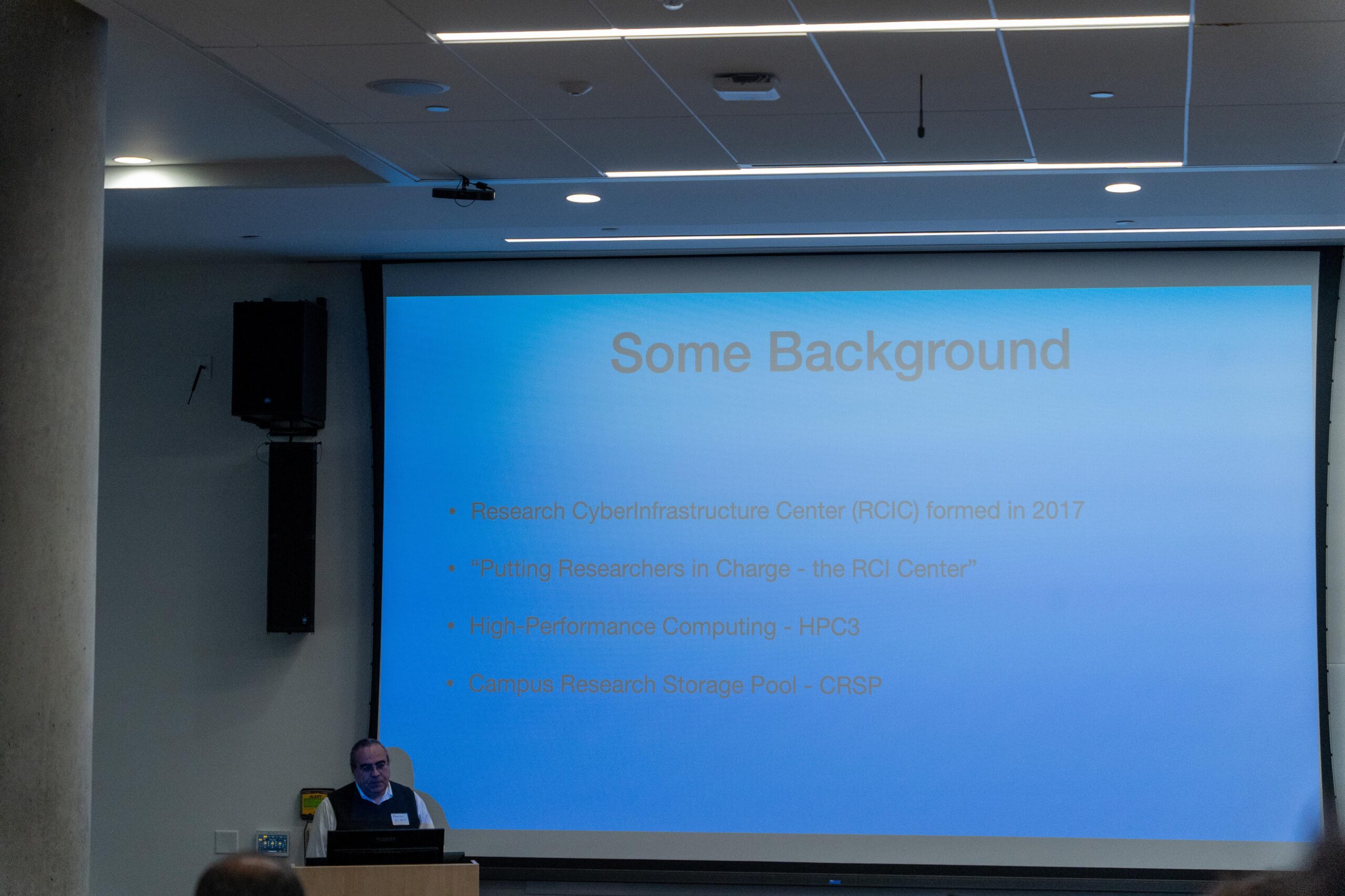
| 2:35 – 2:45 | Bringing High Performance Computing to Texera Research Cyberinfrastructure Center (RCIC) · Francisco Lopez |
| 2:45 – 3:15 | Break and demos |
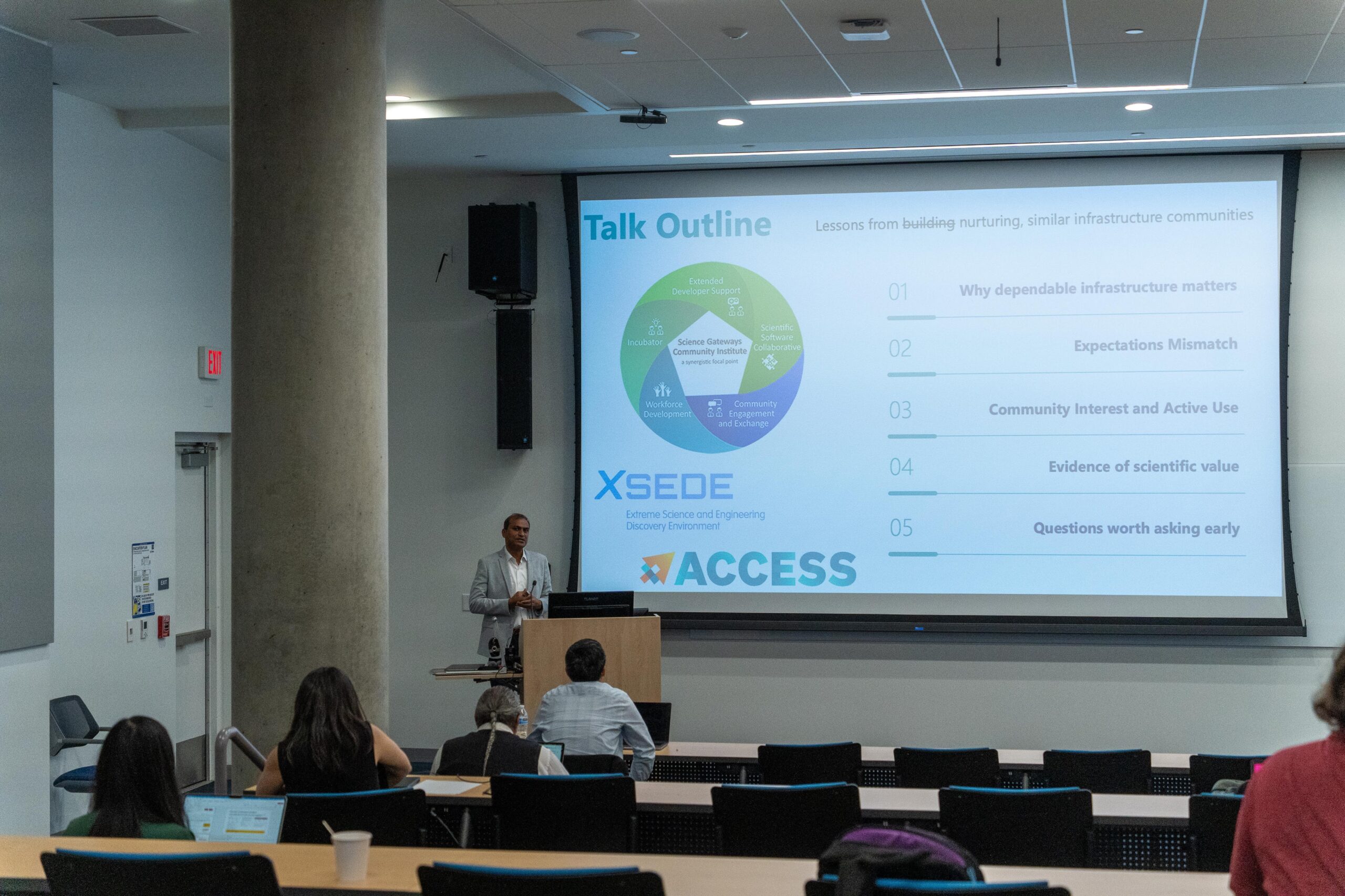
| 3:15 – 3:45 | Building the Bridge While Scientists Cross It Invited talk · Suresh Marru (Georgia Tech) Slides (PDF) |
| 3:45 – 4:15 | From AI Research Innovations to Tools for Scientists: Building and Scaling Intelligent Data Workflows with NSF BRIDGE Invited talk · Jia Zou (ASU) |
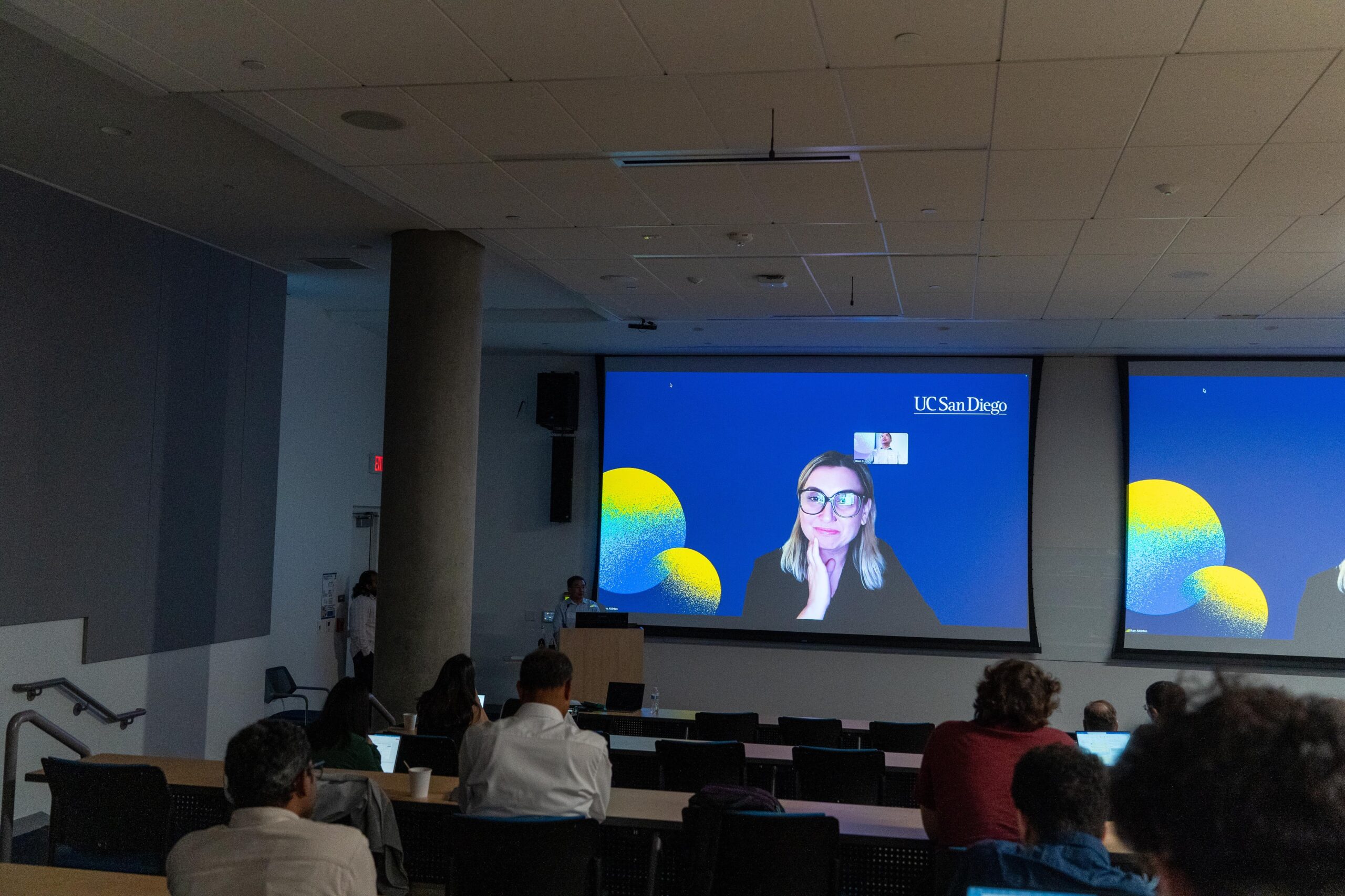
| 4:15 – 4:40 | National Data Platform: From Pilot to National Scale Invited talk · Ilkay Altintas De Callafon (UCSD) |
| 4:40 – 5:00 | Closing remarks Chen Li |
Photos
Click anywhere to view the full album on Google Photos →
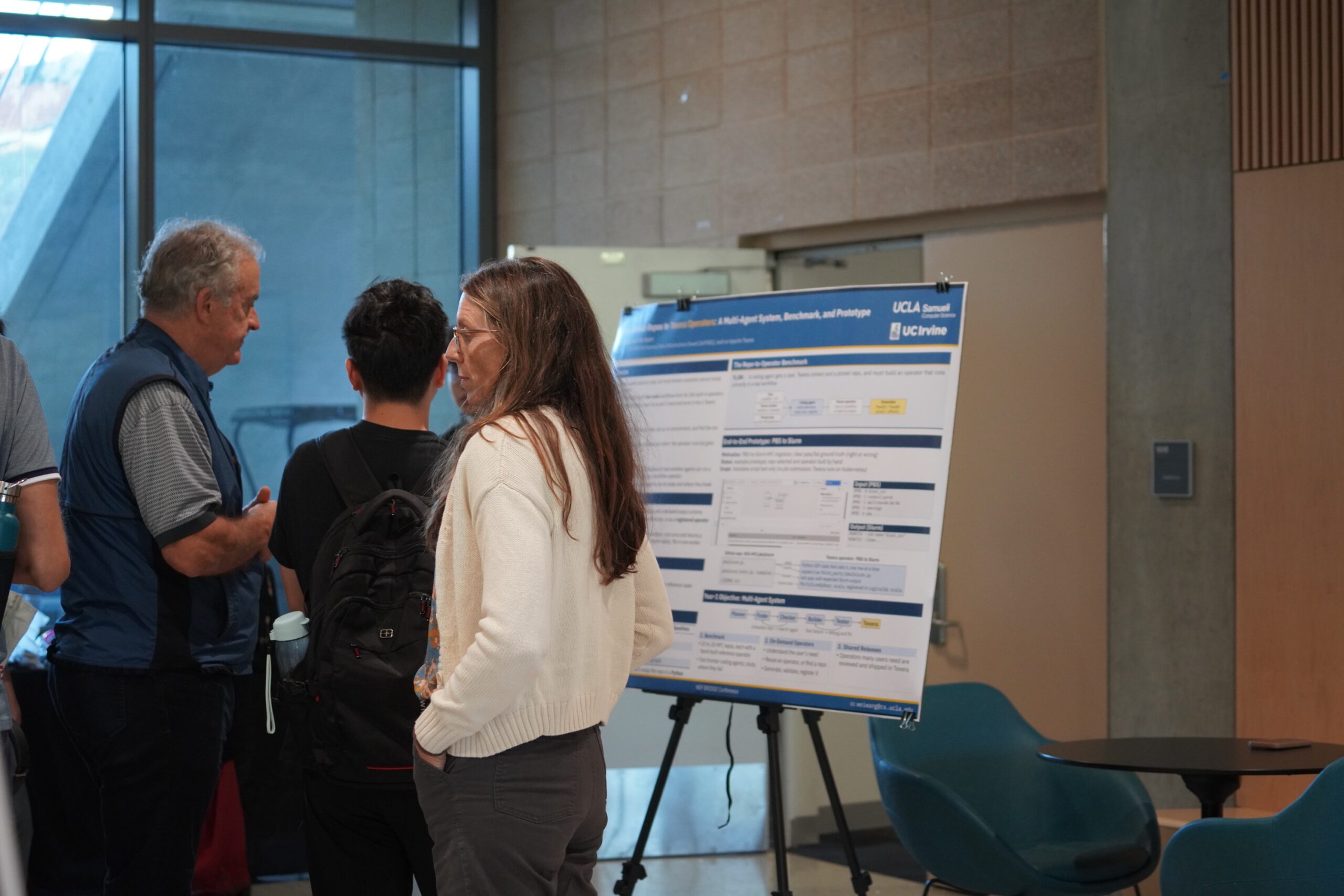
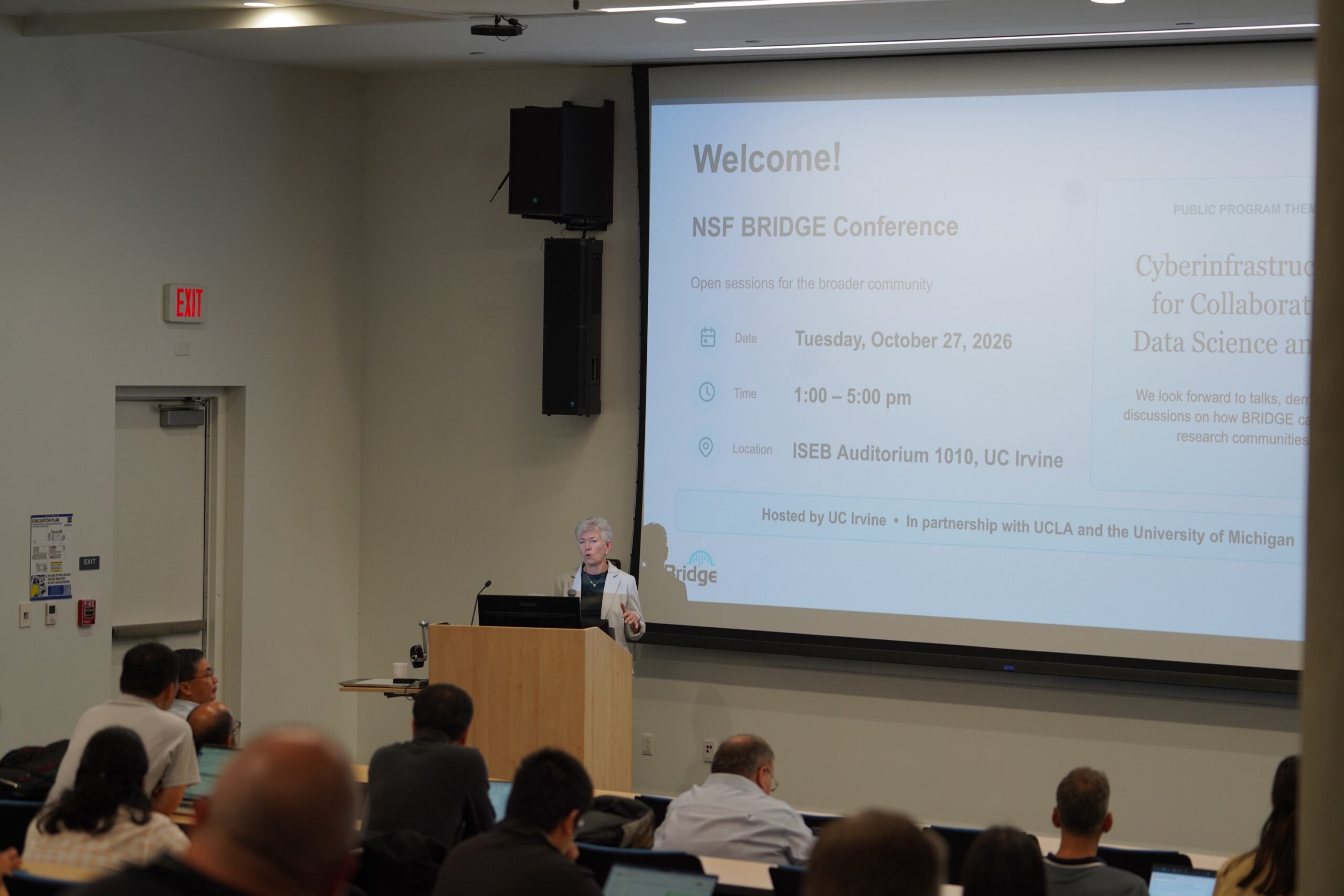
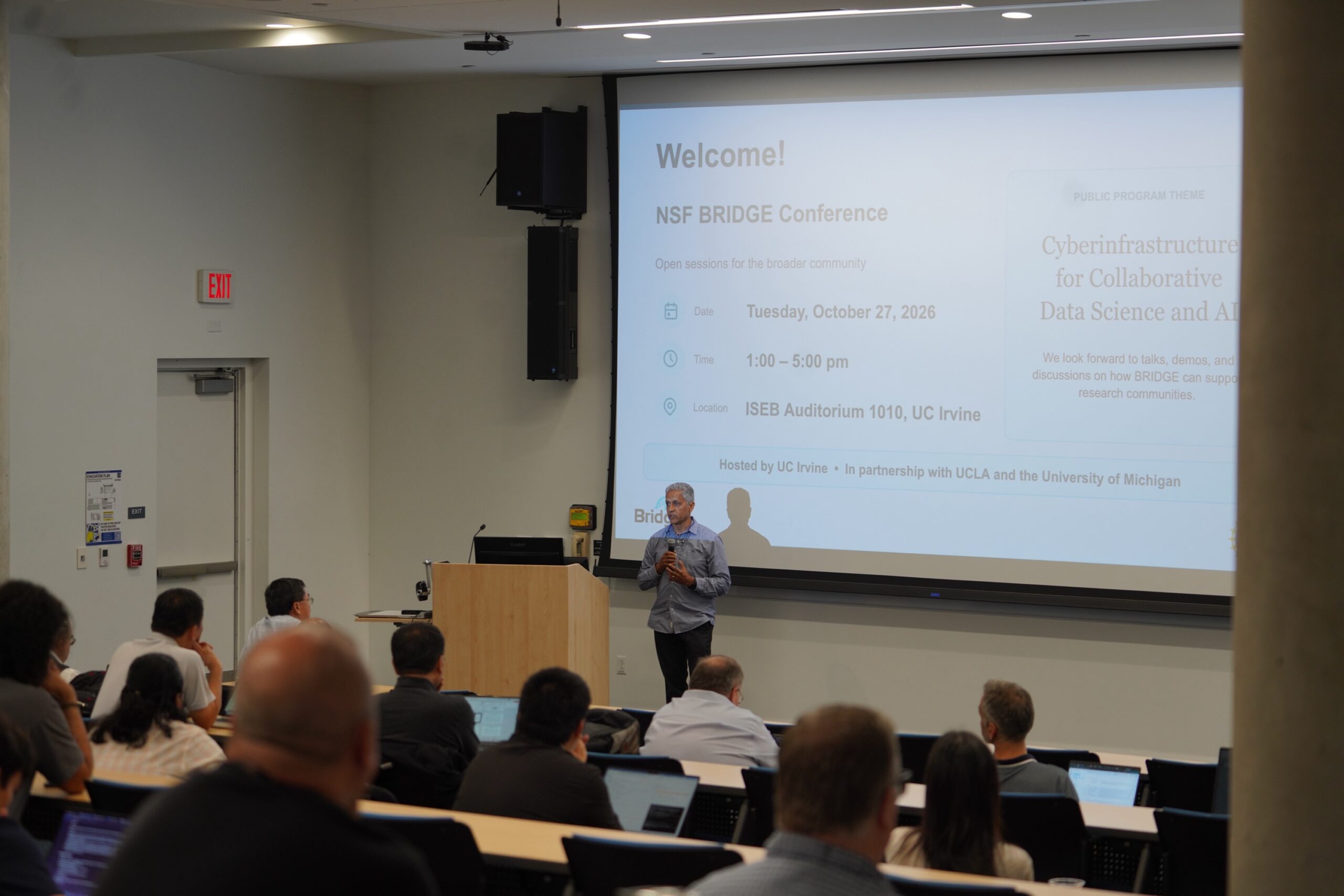
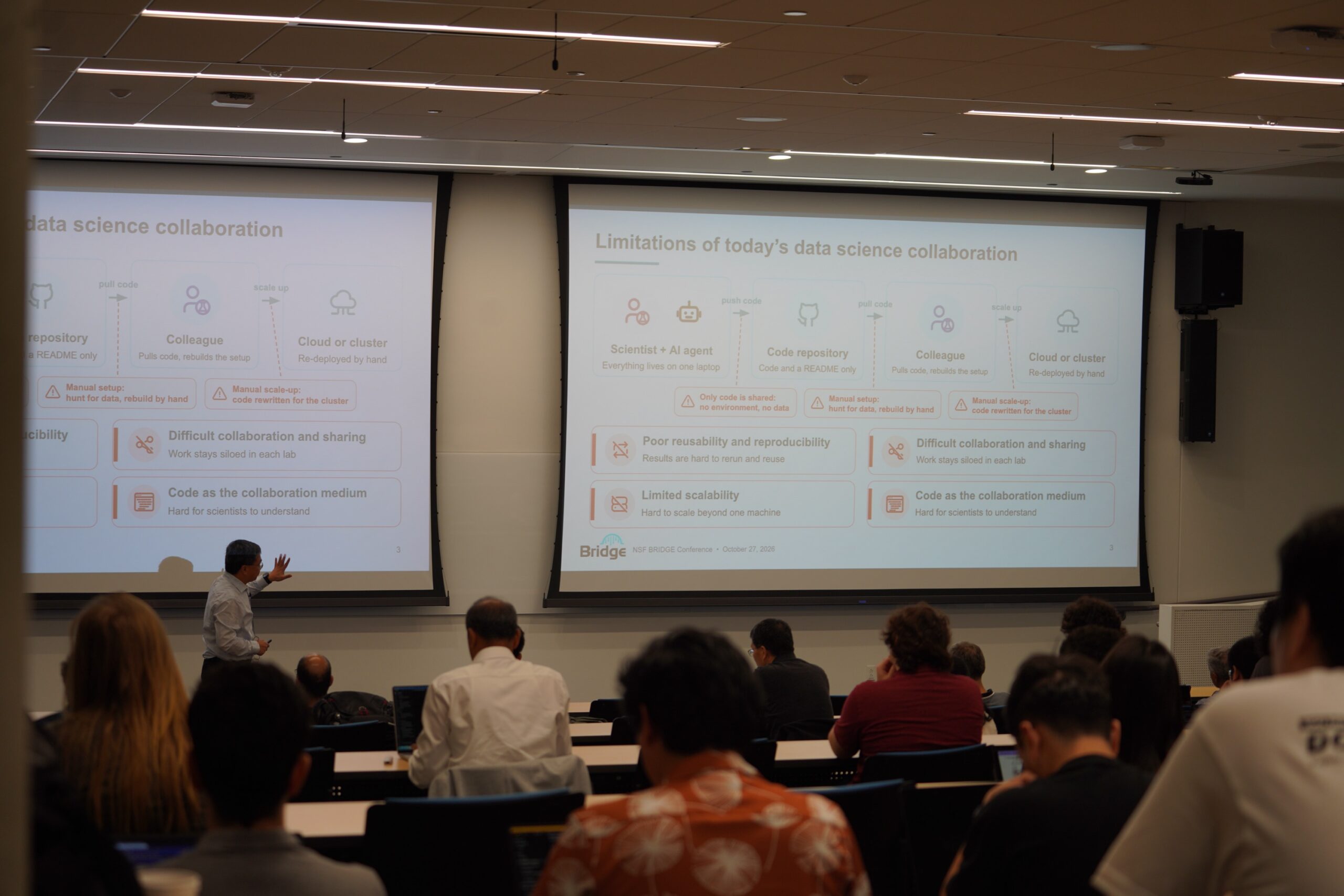
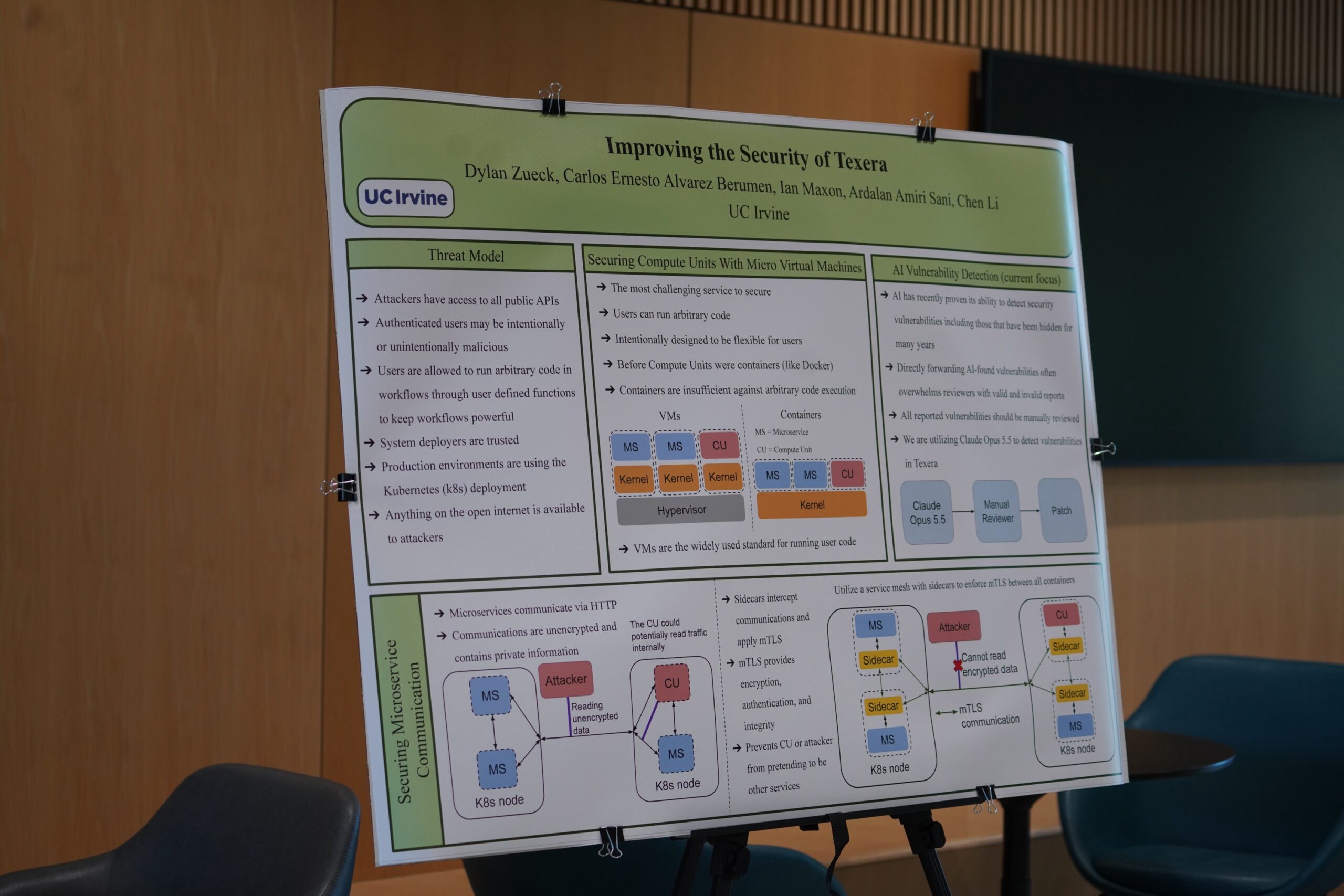
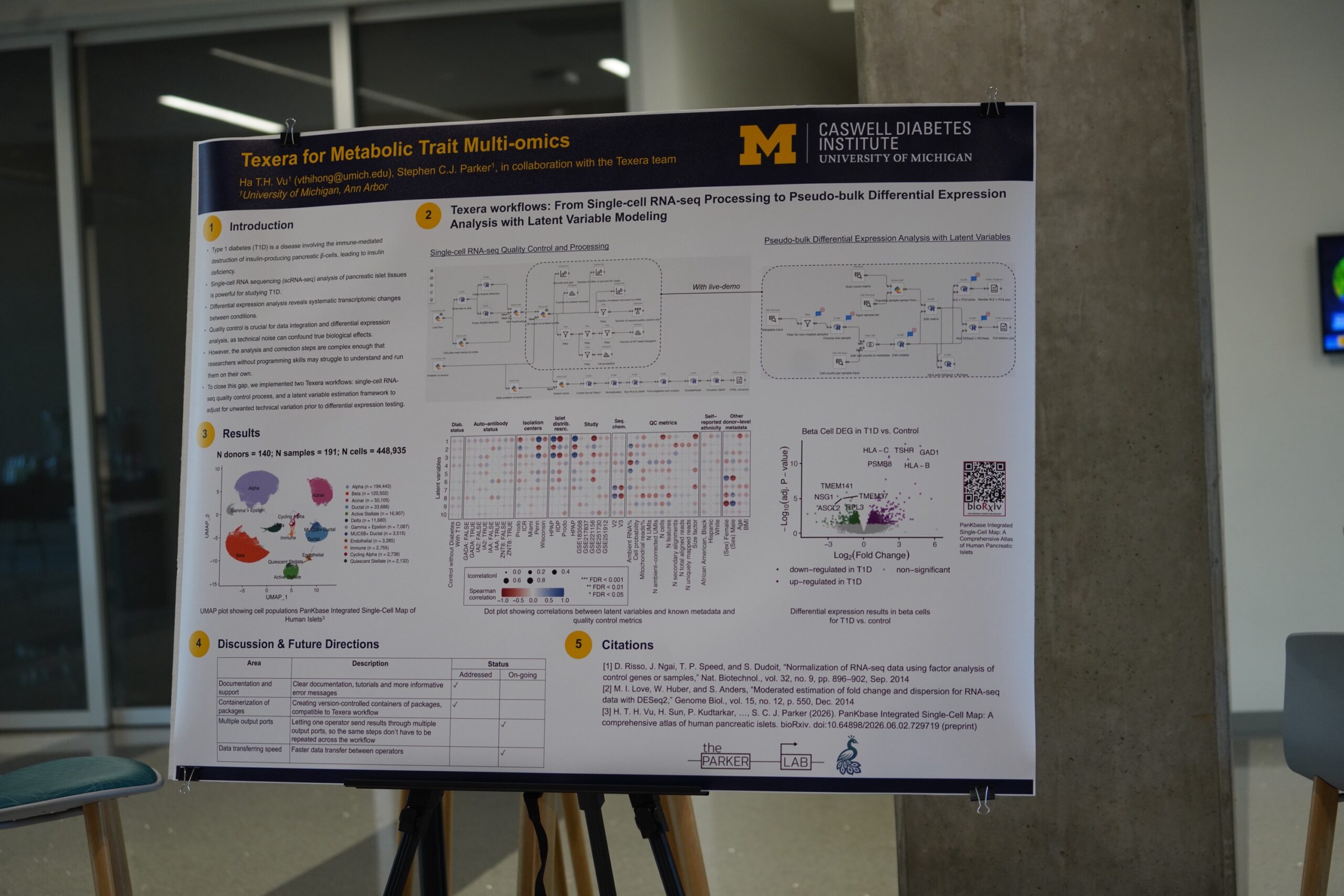
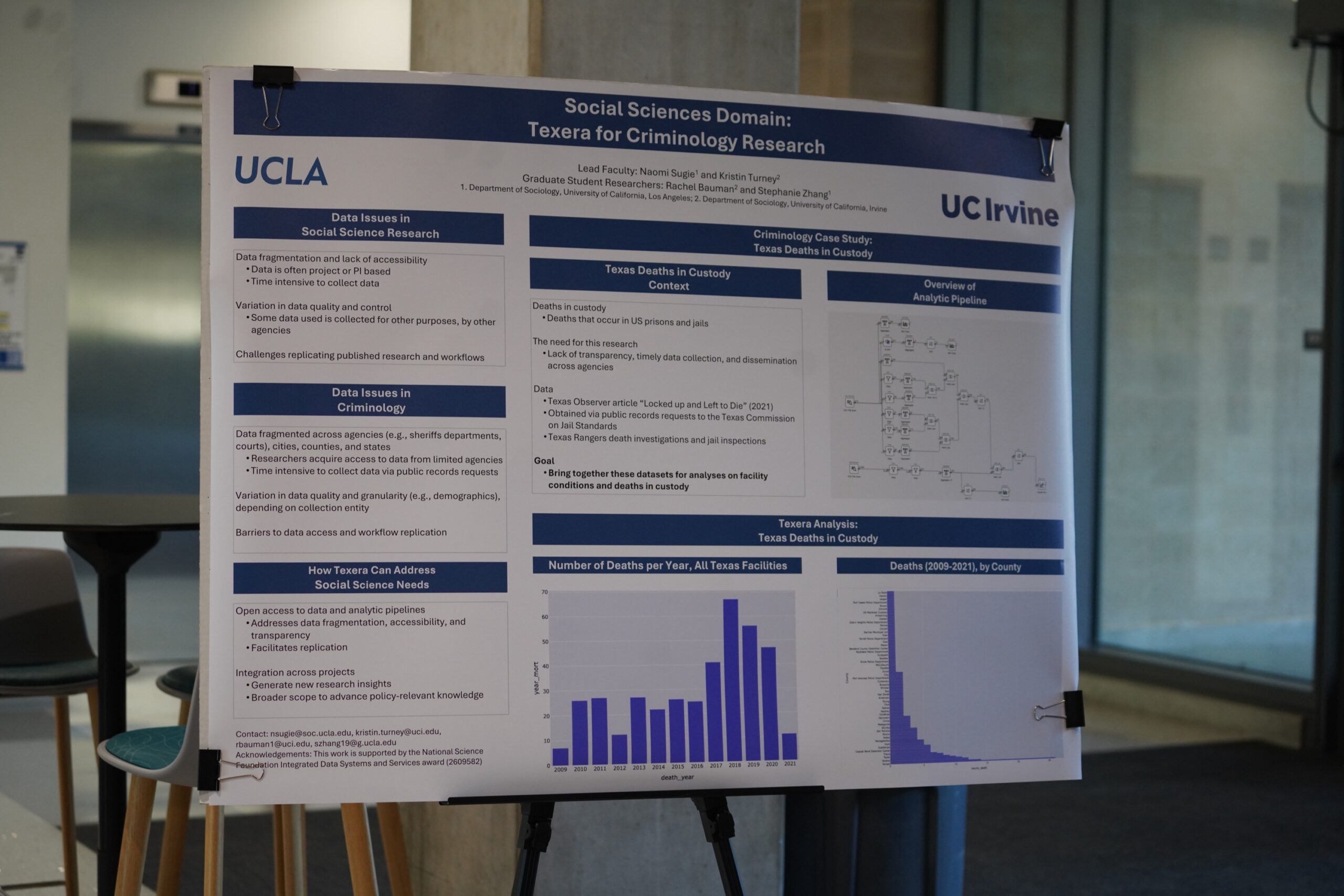
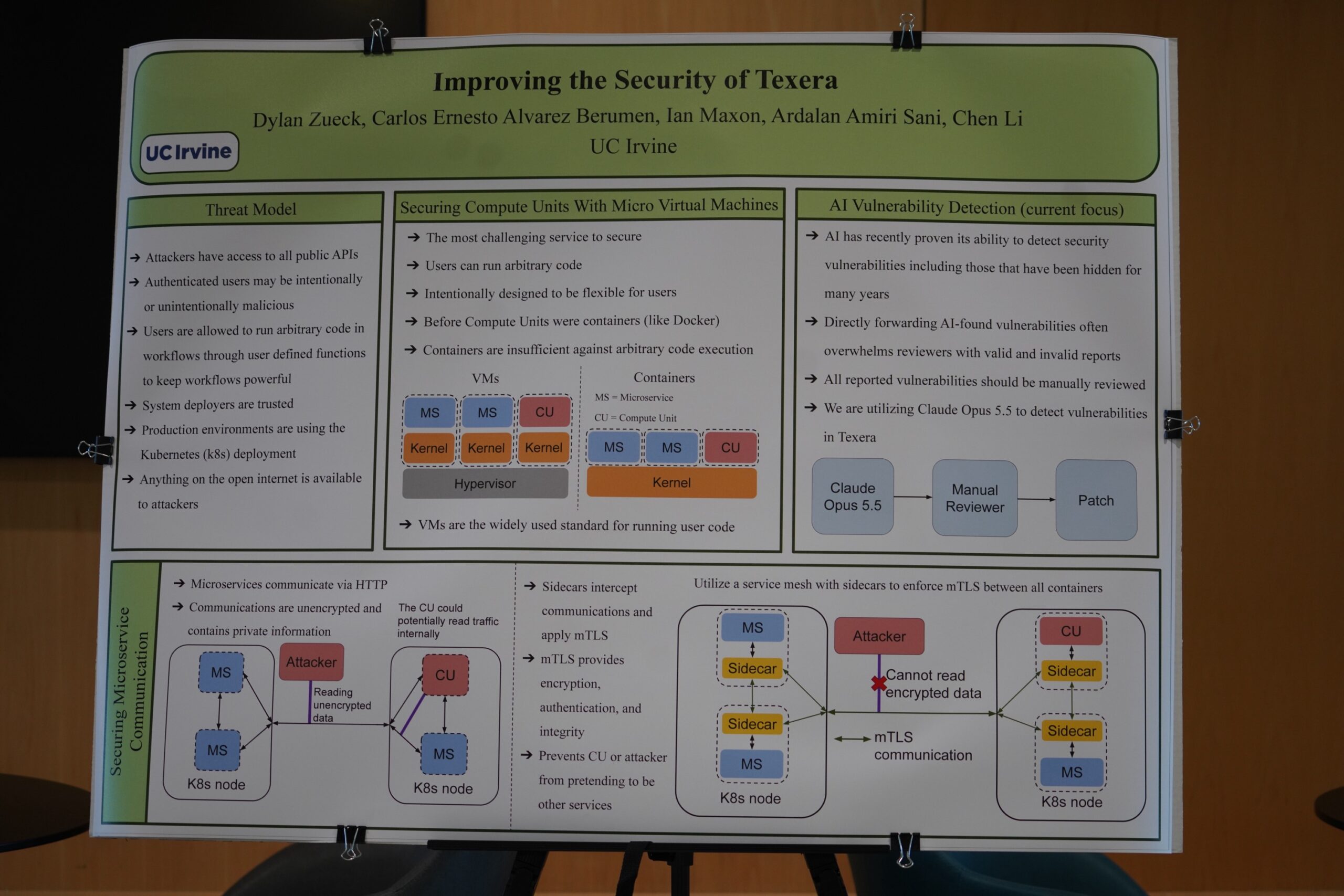
What this conference is for
Sharing progress
Present the latest from BRIDGE and the Texera platform, from new workflow tooling to domain-specific AI assistants.
Connecting communities
Bring together labs and domain scientists across BRIDGE’s five initial communities, so data and knowledge flow across boundaries.
Shaping the roadmap
Gather feedback from users and partners to guide BRIDGE’s priorities for usability, scalability, and reproducibility.
Who should attend
Research labs
Groups looking for a shared, reproducible workspace for data, workflows, and models.
Domain scientists
Researchers who want modern data science and AI with little or no code.
Partners & educators
Collaborators, infrastructure providers, and instructors interested in adopting or teaching the platform.
Invited talks
Guest speakers share their experience building science gateways and bringing AI research into tools scientists can use.
Bridging AI and Biomedical Research
Rui Chen, Xiangmin Xu, and Steve Parker · UC Irvine and University of Michigan
Abstract. Recent advances in single-cell technologies have transformed biomedical research by enabling scientists to study individual cells at unprecedented resolution, revealing cellular diversity, disease-associated changes, and complex biological processes. Together with other emerging technologies, these approaches are generating vast amounts of data and creating exciting opportunities for artificial intelligence (AI) to accelerate scientific discovery. Recent developments in AI foundation models, such as AlphaGenome and emerging virtual cell models, demonstrate the potential to uncover biological relationships, predict the effects of genetic changes, and model cellular responses. However, analyzing the large-scale datasets generated by these cutting-edge technologies and effectively leveraging powerful AI tools remain significant challenges for many biomedical investigators due to the specialized computational expertise, infrastructure, and resources required. To address these challenges, we will discuss the plan of developing VisionKB, an AI-enabled knowledge and analysis platform designed to make advanced computational tools more accessible to the broader biomedical research community. By leveraging Texera’s scalable, collaborative, and user-friendly data science infrastructure, we aim to accelerate the development of customized analytical workflows and AI models tailored to the needs of the vision research community, bridging the gap between rapidly advancing AI technologies and their practical applications in biomedical research.
Open Data and Shared Workflows for Criminal Legal Research: A Texera Case Study
Naomi Sugie · UCLA
Abstract. Social science researchers studying criminology and the criminal legal system (e.g., policing, courts, jails, prisons) need shared repositories and platforms for open access and integration. Texera addresses two primary needs in this domain: first, researchers need open access to data and analytic pipelines. Data are difficult to access because the system is fragmented: agencies (e.g., sheriffs departments, courts) collect data in incompatible ways, and cities, counties, and states maintain separate systems with distinct standards. Second, researchers need integration across projects to generate new research insights. Most research on the context and consequences of jail incarceration is single-county or short-term and remains disconnected from broader empirical debates relating to criminology theory, criminal legal policy, and practice. We present a case study illustrating how Texera can support data and workflow access for improving understanding about deaths in custody in Texas. We describe ongoing work to develop an integrated platform for researchers to advance social science and policy-relevant knowledge.
Bio. Naomi F. Sugie is professor of sociology at the University of California, Los Angeles. She studies punishment and inequality, including barriers to reentry after incarceration and consequences of criminal legal contact for employment, health, government benefits, and political participation. She is co-founder of PrisonPandemic, an archive of stories contributed by people living through COVID-19 in California prisons and jails. She has a Ph.D. in Sociology and Social Policy, as well as a specialization in Demography, from Princeton University.
Bringing High Performance Computing to Texera
Francisco Lopez · Research Cyberinfrastructure Center, UC Irvine
Abstract. The Research Cyberinfrastructure Center (RCIC) has been engaging with the BRIDGE team to make high performance computing resources available to Texera users. We are investigating options to allow jobs to be launched from the Texera interface using the cluster’s default scheduling mechanisms. Using containers and virtual networks, the jobs will be isolated from the cluster to maintain the overall security of the system while allowing the jobs to be managed externally. We are also exploring an option of running Texera jobs as an application under JupyterHub.
Bio. Francisco is an IT professional working in the Research Cyberinfrastructure Center (RCIC) at the University of California, Irvine. RCIC serves the campus research community via a mid-scale (roughly 11K cores and 150 GPUs) computing cluster and about 8 PB of parallel storage. Francisco has over 30 years of experience with UNIX systems and 10 years working with high performance computing.
Building the Bridge While Scientists Cross It
Suresh Marru · Georgia Tech
Abstract. Science gateways empower researchers to use advanced computing, data, and scientific instruments. Successful gateways understand how scientists actually work, decide what to share and what must remain flexible, earn users’ trust, and sustain the people and services behind the software. Drawing on more than two decades of firsthand experience with Science Gateways, Apache Airavata, Cybershuttle, and Nexus, I will share a series of choices that worked, approaches that did not, and lessons that emerged as both platforms and their communities grew. I will connect these lessons into practical advice for prioritizing early investments and evaluating progress through scientific outcomes.
Bio. Suresh Marru is Director of Georgia Tech’s Center for AI in Science and Engineering (ARTISAN) and a Research Professor in the College of Computing. For more than two decades, his work has focused on making advanced computing accessible to scientists through open-source, community-driven cyberinfrastructure. He is a member of the Apache Software Foundation and Vice President of Apache Airavata, an open-source platform for scientific workflows across distributed computing resources. His current efforts include Cybershuttle, which connects researchers and their workflows across personal, campus, cloud, and national computing environments, and Nexus, Georgia Tech’s unified platform for AI and scientific computing.
From AI Research Innovations to Tools for Scientists: Building and Scaling Intelligent Data Workflows with NSF BRIDGE
Jia Zou · Arizona State University
Abstract. Researchers across computer science are developing new data science and AI techniques to help domain scientists work with complex and heterogeneous scientific data. A major challenge is moving these innovations beyond research prototypes and making them accessible, reusable, and trustworthy for broader scientific communities. In this talk, I will present TreeMorpher, an LLM-based approach that helps scientists transform heterogeneous data into common, analysis-ready formats. Rather than writing detailed transformation programs, users specify a target table and a few examples, and an LLM helps construct a workflow that converts diverse source datasets into the desired format. Using metabolic-trait evidence synthesis as an example, I will show how TreeMorpher can standardize study data that differ in terminology, units, cohort descriptions, and table structures. NSF BRIDGE, powered by Apache Texera, provides a broader platform for bringing innovations like this to more users. Texera allows scientists to execute AI-generated workflows, inspect intermediate results, verify transformations, and refine them before downstream analysis. More broadly, the talk illustrates how BRIDGE can help turn advances in AI and data science into practical, reusable tools for scientists across many domains.
Bio. Jia Zou is an Assistant Professor of Computer Science and Engineering at Arizona State University, where she directs the CACTUS Lab. Her research focuses on data-intensive systems for artificial intelligence, including AI-enabled data transformation, data and machine learning co-optimization, model management, and data systems for scientific and emerging AI applications. Her work has been published at leading data management and systems venues, including SIGMOD, VLDB, and ICDE. She received an NSF CAREER Award, an Amazon Research Award, and an IBM Faculty Award, and her work received a VLDB Best Paper Honorable Mention and a SIGMOD Research Highlight Award. Before joining ASU, she was a Research Scientist at Rice University and a researcher at IBM Research. She received her Ph.D. from Tsinghua University.
National Data Platform: From Pilot to National Scale
Ilkay Altıntaş · San Diego Supercomputer Center, UC San Diego
Abstract. AI-driven research not only depends on computing power, but access to data, tools and services. The National Data Platform (NDP) is working to bridge these gaps by connecting researchers with data and computing resources across institutions and environments. This presentation will explore NDP’s contributions to the NAIRR Pilot, what the team has learned from supporting AI-enabled research, and how that work is shaping NDP’s next phase as a Category I project under NSF’s Integrated Data Systems and Services (IDSS) program. We will also discuss how BRIDGE researchers can work with NDP as we collectively build the foundation for AI-ready research, education and innovation.
Bio. Dr. İlkay Altıntaş is Chief Data Science Officer at the San Diego Supercomputer Center, UC San Diego; a Founding Faculty Fellow of the Halıcıoğlu Data Science Institute; and Founding Director of the Societal Computing and Innovation Lab. Her work advances reusable, scalable, and accessible data and AI systems that address complex societal challenges. She founded the WIFIRE Program and the Wildfire Science and Technology Commons, and serves as Principal Investigator of the NSF National Data Platform. She also holds a joint appointment at Los Alamos National Laboratory. Altıntaş received the IEEE TCSC Award for Excellence in Scalable Computing and the ACM SIGHPC Emerging Woman Leader in Technical Computing Award. She served on the IEEE Computer Society Board of Governors and was appointed by Governor Gavin Newsom to California’s Wildfire Technology Research and Development Review Advisory Board. She is a board member of the Climate and Wildfire Institute, and the Data Science Alliance. She earned her Ph.D. from the University of Amsterdam.